

Chapter test · Chemistry · Class 11
Hydrocarbons
This test asks up to 25 questions on the real pattern and marking, and hands you a concept-by-concept report the moment you finish. It covers 3 key concepts: Alkanes, Alkenes and alkynes and Aromatic hydrocarbons.
Start this test free →See a sample questionFree chapter tests included with your account — no card needed.
Questions
Up to 25 — 20 MCQ + 5 numerical
Time
60 minutes, fixed
Marking
JEE Main: +4 / −1 on A, +4 / 0 on B
Class
Class 11 · Chemistry
Report
Concept breakdown + cognitive demand, instantly
What this test covers
3 key concepts, tested the way the exam tests them.
Mapped from EduPeak’s learning framework for this chapter — the same map your report scores you against.
- 1Alkanes
- Explains alkane preparation, conformations and free-radical halogenation.Apply & Analyse
- 2Alkenes and alkynes
- Applies addition chemistry of alkenes/alkynes with regio- and stereochemical rules.Apply & Analyse
- 3Aromatic hydrocarbons
- Explains aromaticity and predicts electrophilic aromatic substitution with directing effects.Apply & Analyse
Level of thinking demanded3 learning objectives
Recall & understandingApply & AnalyseHigher-order
This chapter is tested mostly at the Apply & Analyse level.
In your board
Where this chapter sits in your syllabus.
The same EduPeak test, found under your own textbook’s chapter name.
- CBSEHydrocarbons✓ in your syllabus
- Gujarat (GSEB)Hydrocarbons✓ in your syllabus
- Madhya Pradesh (MPBSE)Hydrocarbons✓ in your syllabus
- Rajasthan (RBSE)Hydrocarbons✓ in your syllabus
- Bihar (BSEB)Unit-XIV Hydrocarbons✓ in your syllabus
- Uttar Pradesh (UPMSP)हाइड्रोकार्बन / Hydrocarbons✓ in your syllabus
- ISC (CISCE)Hydrocarbons✓ in your syllabus
- Cambridge International A LevelHydrocarbons (AS · A2)✓ in your syllabus
- IB Diploma Programme (HL)3.3 Electron sharing reactions (Reactivity 3: What Are the Mechanisms of Chemical Change?)✓ in your syllabus
Try one
A sample question from this chapter.
Drawn fresh from the chapter’s bank on every visit. Reveal the worked solution when you are ready — the way your report explains every question.
SampleChemistry· MCQ+4 / -1
The correct order of reactivity in electrophilic substitution reaction of the following compounds is: is benzene, is toluene (ring bearing ), is chlorobenzene (ring bearing ) and is nitrobenzene (ring bearing ), as drawn.
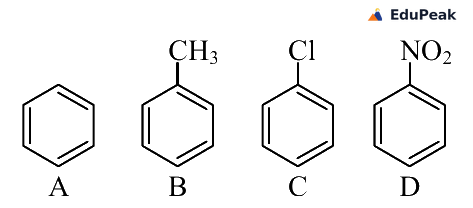
- A.
- B.
- C.
- D.
Worked, step by step — the way your report explains every question. Loads on request.
In the real test, every question is fresh from the chapter’s bank — and your report shows the worked solution for each one.
Keep climbing
Related Class 11 Chemistry chapters
Some Basic Concepts of ChemistryStructure of AtomClassification of Elements and PeriodicityChemical Bonding and Molecular StructureStates of MatterThermodynamics
Good to know
About this chapter test
How is the test scored?
Exactly like JEE Main: +4 for a correct answer, −1 for a wrong MCQ, and no negative marking on numericals. Your total, pacing and concept-by-concept accuracy appear in your report the moment you submit.
Which class is Hydrocarbons in?
Hydrocarbons sits in Class 11 Chemistry here. Pick your class when you start — the whole chapter list is organised the same way.
Can I take it more than once?
Yes — each attempt draws from the chapter’s bank, and your report tracks your best and your progress across attempts.
Is it free?
Free chapter tests are included with every account, and each one comes with the complete report. No card needed to start.
25 questions. 60 minutes. One honest answer.
Find out exactly where you stand on this chapter — today.
Start this test free →