

Chapter test · Chemistry · Class 11
Equilibrium
This test asks up to 25 questions on the real pattern and marking, and hands you a concept-by-concept report the moment you finish. It covers 4 key concepts: Chemical equilibrium and K, Le Chatelier’s principle, Ionic equilibrium: acids, bases and pH and Buffers, hydrolysis and solubility equilibria.
What this test covers
4 key concepts, tested the way the exam tests them.
Mapped from EduPeak’s learning framework for this chapter — the same map your report scores you against.
- 1Chemical equilibrium and K
- Applies the law of mass action, relates Kp and Kc, and computes equilibrium compositions.Apply & Analyse
- 2Le Chatelier’s principle
- Predicts equilibrium shifts under concentration, pressure, temperature and catalyst changes.Apply & Analyse
- 3Ionic equilibrium: acids, bases and pH
- Computes pH for strong/weak acids and bases and applies ionisation constants.Apply & Analyse
- 4Buffers, hydrolysis and solubility equilibria
- Applies Henderson-Hasselbalch, salt hydrolysis and Ksp with the common-ion effect.Apply & Analyse
This chapter is tested mostly at the Apply & Analyse level.
In your board
Where this chapter sits in your syllabus.
The same EduPeak test, found under your own textbook’s chapter name.
- CBSEEquilibrium✓ in your syllabus
- Gujarat (GSEB)Equilibrium✓ in your syllabus
- Madhya Pradesh (MPBSE)Equilibrium✓ in your syllabus
- Rajasthan (RBSE)Equilibrium✓ in your syllabus
- Bihar (BSEB)Unit-VIII Equilibrium✓ in your syllabus
- Uttar Pradesh (UPMSP)साम्यावस्था / Equilibrium✓ in your syllabus
- ISC (CISCE)Equilibrium✓ in your syllabus
- Cambridge International A LevelEquilibria (AS · A2)✓ in your syllabus
- IB Diploma Programme (HL)2.3 How far? The extent of chemical change (Reactivity 2: How Much, How Fast and How Far?) · 3.1 Proton transfer reactions (Reactivity 3: What Are the Mechanisms of Chemical Change?)✓ in your syllabus
Try one
A sample question from this chapter.
Drawn fresh from the chapter’s bank on every visit. Reveal the worked solution when you are ready — the way your report explains every question.
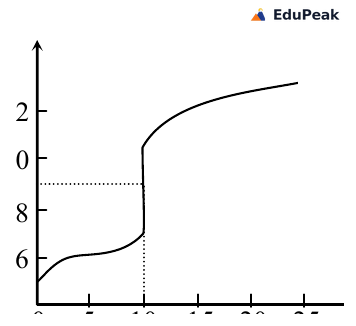
The number of the following statements which is/are correct about phenolphthalein is:
(A) It can be used as an indicator for the titration of a weak acid with a weak base.
(B) It begins to change colour at .
(C) It is a weak organic base.
(D) It is colourless in acidic medium.
Keep climbing
Related Class 11 Chemistry chapters
Good to know
About this chapter test
How is the test scored?
Which class is Equilibrium in?
Can I take it more than once?
Is it free?
25 questions. 60 minutes. One honest answer.
Find out exactly where you stand on this chapter — today.
Start this test free →